
Why Shipping Companies Aren’t All Responsible for the Same Things
Every day, delivery trucks from FedEx, UPS, and USPS drive through neighborhoods, highways, and business districts all over the country. When accidents happen, like a rear-end collision, a pedestrian getting hit, or property damage, victims often think that the legal process for filing a claim against any delivery company is the same. That idea could cost you a lot.
The truth is that who hit you is just as important as how they hit you. USPS is a federal agency that follows different rules than FedEx and UPS, which are private companies that follow state tort law. These differences determine which court system will hear your case, what deadlines apply, who can be named as a defendant, and, in the end, how much money you may be able to get. If you’re considering filing a claim against a shipping company for a truck accident, understanding these distinctions is crucial.
This article goes over the laws, procedures, and real-world problems that come up when you try to file injury claims against each carrier. If you know the differences between these types of accidents, you can make better choices after a delivery vehicle accident, whether you’re a driver, pedestrian, cyclist, or property owner.
The Laws That Apply to Shipping Company Accidents
Most cases of delivery vehicle injuries are based on negligence. This means that the driver had a duty to keep you safe, but they broke that duty by driving recklessly or breaking traffic laws, which caused your injuries and you suffered measurable damages. [1]
Vicarious liability (also called respondeat superior) lets victims hold the employer responsible for the employee’s negligence when the driver is an employee doing their job. [2] This is important because employers usually have higher insurance limits than individual drivers. A skilled truck accident lawyer can help you navigate the complexities of vicarious liability.
But the difference between an employee and an independent contractor makes things very hard. When delivery companies say that drivers are independent contractors instead of employees, they often say that they shouldn’t have to share responsibility. This leaves victims to go after individuals or small contracting companies with little insurance. [3]
The company involved decides more than just the person’s job status:
- Which court system is in charge (state or federal)
- What rules do you have to follow for your claim (standard civil procedure vs. Federal Tort Claims Act)?
- Defendants and insurance resources that are available
- Deadlines for filing and settling
Liability Basics for Private Shipping Companies (UPS and FedEx)
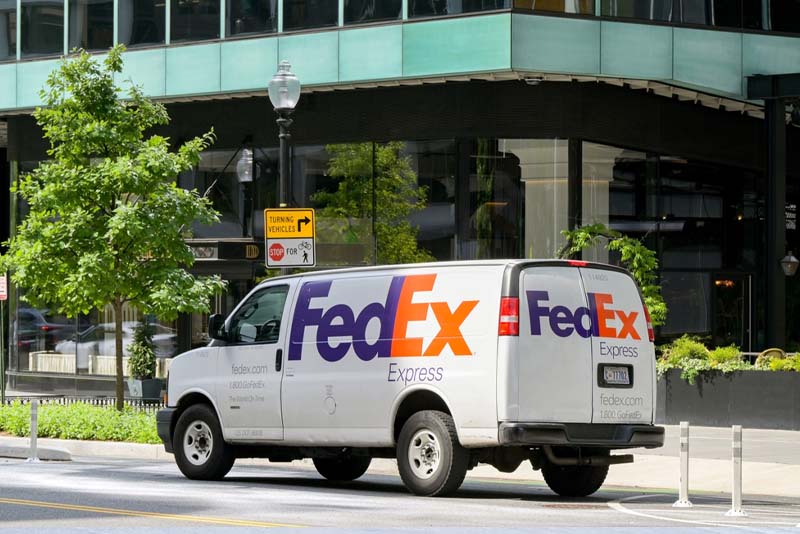
When someone is hurt by a private carrier like FedEx or UPS, they usually sue the driver for their own negligence and the company for vicarious liability, negligent hiring, lack of training, poor supervision, or maintenance problems. These cases are all about commercial auto insurance. Liability limits for large carriers are much higher than those for personal auto policies, as regulated by the Federal Motor Carrier Safety Administration (FMCSA). This means that in cases of serious injury, the amount of money available for compensation is higher.
Rear-end and intersection accidents, pedestrian and cyclist injuries during neighborhood deliveries, damage to parked cars and buildings, and injuries at loading docks are all common types of accidents. If you’ve been involved in such an incident, a personal injury lawyer can provide expert guidance.
Private carriers use the same defenses over and over again: they say the driver wasn’t “on the job” when the accident happened, they say the driver was an independent contractor and not covered by vicarious liability rules, they blame the victim’s comparative negligence, or they question the cause and severity of the injury.
A Look at FedEx’s Liability
Insurance and Business Structure
FedEx’s legal problems come from its independent service provider (ISP) model, especially in FedEx Ground operations. There are many routes that are run by different contracting companies. These companies hire drivers, own or lease trucks, carry their own commercial insurance, and take care of day-to-day supervision. This complex structure can make it difficult to determine liability after a FedEx truck accident.
Because of this, liability can be shared by the driver, the local contractor, and FedEx corporate, but only if you can show that the corporation has enough control. FedEx Express drivers are more likely to be direct employees, which makes it easier to file vicarious liability claims than with many Ground drivers.
Pros and Cons of FedEx Injury Claims
FedEx often says that Ground drivers are independent contractors and not employees. This can make it harder or take longer to get to FedEx’s resources. Victims often have to figure out which contracting company, its insurance company, and which FedEx division was involved (Ground vs. Express). The Department of Labor provides guidance on employee misclassification.
But courts can use the right-of-control test instead of just looking at labels. If FedEx or a contractor has strict rules about routes, uniforms, equipment, and performance, courts may see drivers as employees for liability reasons.
Violating Federal Motor Carrier Safety Administration (FMCSA) rules, hiring people without doing due diligence, or not keeping up with maintenance can also make a company liable.
When It’s Easier or Harder to Sue FedEx
FedEx claims are easier to win when they involve FedEx Express or when the driver is clearly a W-2 employee. They are also easier to win when there is strong evidence of in-course-of-employment driving (such as an active route, package scanning, a company vehicle, and GPS logs) and when you can show that the company or contractor broke safety rules. A FedEx truck accident lawyer can help gather and analyze this evidence.
FedEx claims are harder to win when there are multiple possible defendants, when there is little corporate control, and when contractor insurance limits are low compared to catastrophic injuries.
Important pieces of evidence are bills of lading, route assignments, dispatch and GPS data, handheld scanner logs, employment or contractor agreements, and proof that FedEx was in charge of the driver’s work.
An Overview of UPS’s Liability
Insurance Coverage and Employment Model
UPS uses a standard model for employee-drivers. Most drivers are full-time employees with benefits and union representation, as described by the Bureau of Labor Statistics. UPS owns and runs its own delivery trucks, and it has corporate liability insurance with high limits.
Since drivers are employees, vicarious liability is usually more direct and less contested than in many FedEx Ground claims.
The Pros and Cons of UPS Injury Claims
The best thing about UPS claims is that it’s easy to prove that the company is responsible. When a UPS truck driver in a uniform hurts someone while on a route, it’s usually easy to see how the driver and the company are connected. If you’ve been injured in a UPS truck accident, a truck accident lawyer can help you pursue your claim.
In cases of serious injury or wrongful death, corporate insurance and assets make it more likely that you will get the full value.
UPS still makes defenses, saying that the driver was off-duty, went off course, or wasn’t doing their job. UPS, like other carriers, questions causation, downplays the severity of injuries, or blames comparative fault.
When It’s Easier—or Harder—to Sue UPS
UPS claims are easier when accidents happen during clearly documented delivery work with no questions about employment status and there is strong evidence—like dashcam footage, telematics data, event data recorder information, or witnesses—showing clear negligence like rear-ending, running red lights, or speeding.
Cases get harder when there isn’t much physical evidence or when UPS questions how bad the injuries are or whether treatment is needed.
UPS usually has set rules for pre-suit and litigation. When liability is clear and injuries are well-documented, some claims can be settled. However, complex or high-value cases may need to go to court to get full compensation.
An Overview of USPS Liability (Claims Against the Federal Government)
Why USPS Is Different in the Eyes of the Law
The Federal Tort Claims Act (FTCA) covers injury claims against USPS because it is considered a federal agency for tort purposes. The FTCA only lets people sue the US for negligence when certain conditions are met.
This means that people can sue the US—not USPS as a private company—for things that federal employees do while they are on the job. An experienced USPS truck accident lawyer can guide you through this unique process.
This means that you are suing the United States and that federal law governs important parts of your case, even though the standards for negligence often come from state law.
How the FTCA Claims Process Works
Victims must first file an administrative claim with the right USPS tort claims office before they can file a lawsuit. They usually do this using Standard Form 95 (SF-95).
Some important FTCA requirements are:
- You have two years from the date of the accident to file an administrative claim
- Claims must include a “sum certain,” which is a specific dollar amount for damages
- Before a lawsuit can be filed, USPS has up to six months to accept, deny, or settle the claim
- If USPS denies the claim or doesn’t do anything within six months, the person who made the claim can sue in federal district court.
Under the FTCA, you don’t have the right to a jury trial. A federal judge decides who is at fault and how much money they owe.
The Pros and Cons of USPS Injury Claims
FTCA claims usually don’t allow punitive damages, so the only damages that can be recovered are compensatory damages.
Missing the two-year administrative deadline, not filing SF-95 with all the required information and a clear sum certain, suing the wrong defendant (naming USPS instead of the United States), and filing in state court instead of federal court after the administrative phase are all procedural mistakes that can permanently bar claims. [4]
Because of required administrative review and federal processing timelines, USPS claims often take longer than similar claims from private carriers.
FedEx, UPS, and USPS: A Side-by-Side Comparison
| Feature | FedEx | UPS | USPS |
| Employment Status | Often independent contractors (Ground) | Typically W-2 employees | Federal employees |
| Ease of Filing | Standard state court, but requires identifying the correct contractor | Standard state court, clear corporate defendant | Requires SF-95 administrative claim, then federal court |
| Procedural Barriers | Contractor disputes, multiple insurers | Fewer procedural issues, focus on fault and damages | Strict FTCA deadlines, no jury trial, punitive damages barred |
| Speed of Resolution | Can be slowed by coverage disputes | Often faster when liability is clear | Slower due to administrative review |
| Possible Compensation | Can be high, but may be limited by contractor’s insurance | High policy limits, punitive damages may be available | Compensatory damages only, no punitive damages |
Which Shipping Company Is the Easiest to Sue?
UPS is often the easiest company to go after in terms of procedures and liability structures. Because drivers are usually employees, UPS is responsible for their actions without having to make complicated arguments about contractors. In strong-liability cases, high policy limits and a clear corporate defendant make strategy easier and give you more power.
FedEx is in the middle, but it can change a lot depending on the situation. The independent contractor/ISP model protects FedEx from automatic liability, so plaintiffs have to show that they were in charge or go after smaller contractor companies. FedEx Express claims and cases with strong proof of corporate control, on the other hand, can still lead to strong results.
USPS is usually the most difficult to follow the rules. These claims are harder to make and less forgiving of mistakes because of strict FTCA deadlines, SF-95 requirements, and the fact that they can only be heard in federal court without juries.
That being said, “easiest to sue” depends a lot on the facts of your case, the evidence you have, and the laws in your area. A FedEx Express case with clear corporate negligence may be stronger than a disputed-fault UPS claim. Also, USPS cases with strong evidence can still lead to big compensatory awards.
Common Errors Victims Make When Filing Shipping Company Accident Claims
In USPS cases, waiting too long is especially risky. If you miss the FTCA’s two-year administrative deadline, your claim will be permanently denied, no matter how clear the negligence is.
Victims often think, “The insurance company will take care of it,” and they never find out if the driver was an employee, contractor, or federal worker.
Other common mistakes are suing the wrong person (like USPS instead of the United States, or only going after a FedEx contractor with limited coverage) and not gathering or keeping important evidence from the scene, vehicles, and company systems like GPS logs, telematics, and scanner data.
When You Should Call a Lawyer After an Accident While Delivering
Legal advice is especially important when there is a serious injury or wrongful death, a disagreement over who is to blame, a crash with multiple vehicles, or an accident involving USPS or a FedEx Ground contractor where it is not clear who is to blame. If you’ve been in a truck accident, seeking advice from a truck accident lawyer is a critical first step.
Early consultation is important because evidence can disappear quickly. Delivery companies keep internal data according to litigation hold procedures, which may not be triggered without formal notice.
The sooner you get a lawyer involved, the more likely you are to get GPS logs, driver communications, maintenance records, and other documents that could make or break your case.
Big Ben Lawyers has a lot of experience with complicated delivery truck accident claims against FedEx, UPS, and USPS. If you have to deal with FTCA administrative requirements, contractor liability disputes, or standard negligence claims, having a lawyer who knows what they’re doing from the start can help you protect your rights and get the most money back.
Knowing the Company Can Affect How Your Case Turns Out
The delivery truck that hit you wasn’t just a car; it was a complicated legal entity with its own rules, procedures, and defenses. Knowing whether you’re dealing with FedEx’s contractor model, UPS’s employee structure, or USPS’s federal framework will directly affect the steps you need to take, how long it will take, and how much your claim might be worth.
These differences shouldn’t stop you from getting the money you deserve. Instead, they are reminders that making smart choices—ideally with the help of a lawyer who has been through the process before—gives you the best chance of getting through these systems and getting fair compensation for your injuries.
Big Ben Lawyers can help you understand your legal options and build the strongest case possible if you’ve been hurt in an accident with a FedEx, UPS, or USPS vehicle. Call us today to talk about your situation and find out how we can help you get the money you deserve.
References
[1] Cornell Law School Legal Information Institute. “Negligence.” [2] Cornell Law School Legal Information Institute. “Respondeat Superior.” [3] U.S. Department of Labor. “Misclassification of Employees as Independent Contractors.” [4] U.S. Postal Service Office of Inspector General. “Tort Claims Management – Western Area.”